Pages

Showing posts with label refugees. Show all posts

Wednesday, February 15, 2012

Strength In What Remains


I came across Tracey Kidder’s Strength In What Remains: A Journey of Remembrance and Forgiveness while killing time in a bookstore waiting for a flight at JFK. I was surprised to find a book on this topic (genocide and its aftermath) in the airport bookstand, so when I got home I picked up a copy from the local library and gave it a read through. The book was publishes in 2009 (by Random House) and goes back and forth between both Burundi and New York City and the past and the present.

The theme of memory flows through much of the book. And in this case, the memories are often hard to swallow. Strength in What Remains follows the true story of Deogratias—from his narrow escape in the brutal conflict in his home country of Burundi to his hunger and homelessness in his new “home” of New York City.

The genocide in Rwanda is much better known to Americans than the genocide in the neighboring country of Burundi. I worked for several years with Burundian refugees in Abilene, so the book was especially interesting to me. My close relationship with so many Burundians, and refugees in general, made the book especially hard to read.

Despite some of the heart wrenching details (many of which came about while Deo was in America)  and the fact that I didn’t find the book to be extraordinarily well written (even though Kidder has won a Pulitzer and other literary awards), I still recommend the book. It will make you thankful for the life you lead and, hopefully, give you a heart of compassion for refugees everywhere. 

Wednesday, January 18, 2012

Everyone Is An Immigrant

A little while ago a friend of mine posted this article from Poetry Magazine onto his facebook captioned with Sensational. I wholeheartedly agree. The prose piece titled "Everyone Is An Immigrant: Poetry and Reportage in Lampedusa" is part poetry, part journalism, part personal journal. Eliza Griswold (who has written for the New Yorker, the Atlantic, the New York Times Magazine, Harper's, and the New Republic) writes from Lampedusa (a small island near Africa that belongs to Italy) and describes what happens as refugees flee to the island from Libya and elsewhere.

Find the piece here and give it a look!


Wednesday, January 4, 2012

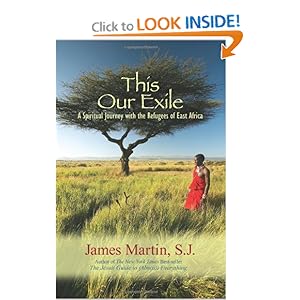
This Our Exile: A Spiritual Journey With the Refugees of East Africa


This Our Exile: A Spiritual Journey With the Refugees of East Africa by James Martin SJ is a great book on the refugee crisis in Africa. It was published in ’99, but is definitely still a relevant read. I checked the book out of the library and read the book a couple of years back on my plane ride to China (crossing my fingers and gambling that I wouldn’t lose the book on my trip!). This was my first introduction to James Martin who has turned out to be my very favorite Jesuit. (He also happens to be the “Official Chaplain” of the Colbert Report if any of you are thinking his name seems familiar.)

The book is a first person account of Father Jim’s time in Kenya helping refugees and the story of how it changed him. Before he became a Jesuit he worked for GE and was on the corporate fast track. He quickly found the corporate world unfulfilling and became a Jesuit instead. In Kenya he puts his business training to use helping refugees, mainly women, set up microenterprises.

In This Our Exile James Martin is part tour guide, part comedian, part historian, part theologian, and, maybe most importantly, part narrator of the stories of the people he meets.

The book is eye opening, easy to read and a great introduction to refugees and those who work with them all over the world. It’s so good in fact, I think I am going to have another read through it!

An excerpt from his introduction:

“The refugees in East Africa, people whom I had only read about in newspapers, people whose lives I (literally) couldn’t begin to imagine, transformed my heart in ways that I also couldn’t have imagined. Their lives, a full measure of sorrows and joys, forced me to confront the basic human questions of what it means to suffer pain and to experience happiness. Seeing how the lives of the refugees continually moved between the twin poles of despair and hope showed me what enables people to continue, despite incredible difficulties, and still believe in a good God. Or, as one redoubtable Rwandese woman (whom you will soon meet) would tell me, “God is very good!” Their magnificent openness to life helped me face my own difficulties more honestly, and to stay in Kenya despite some strong temptations to leave. Most especially, in coming to know the refugees, and in being invited into their lives, I came to know more fully what it means to love and be loved.”